
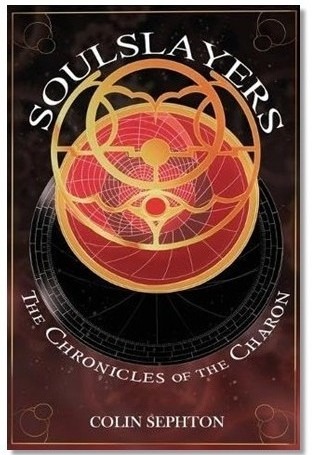
In the 3rd book of the trilogy, Soulslayers From the Chronicles of the Charon, Colin Sephton continues his sweeping saga where science, mysticism, and mortality collide. This time the battle is not for time itself, but for the human soul. Ignatius Isambard, Indigo Gemstone, and the relentless machinery of empire all return, but each is changed scarred by death, revelation, and resurrection. In a world powered by steam and haunted by gods, Soulslayers asks: when the soul can be altered, is humanity still human? This Soulslayers review 2 offers a deeper insight into these themes.
Between Steam and Spirit: Ignatius, Indigo, and the Shadow of the Charon
Sephton’s Soulslayers fuses steampunk precision with cosmic terror. Brass engines hum beside metaphysical doors to the afterlife, and through it all, the Charon, those seven divine arbiters of existence, remain the silent thread connecting fate, energy, and eternity. As the Union Jacks seek new power to strengthen the Empire, they tamper with realms beyond their comprehension.
As we explore the intricate layers of this narrative, the Soulslayers review 2 reveals the profound implications of the choices faced by its characters.
In Soulslayers, technology becomes theology. Each invention echoes the rhythm of creation itself, and each soul carries the potential to destroy or redeem the cosmos. The novel shows that the borders between magic, science, and belief have never been thinner.
Ignatius Isambard: The Healer Who Courts Damnation
Ignatius returns as both scientist and prophet. His sonic inventions, machines that move matter through vibration, reflect his obsession with understanding the fabric of reality. But after witnessing Indigo’s death and miraculous rebirth, Ignatius’s pursuit of knowledge becomes an act of penance. He can heal wounds and summon energies from other planes, yet every miracle costs him a piece of himself.
Through Ignatius, Sephton questions the cost of enlightenment. Is progress worth the erosion of the soul? His trembling hands and haunted birthmark suggest that knowledge without restraint is not salvation, it is contagion.
Indigo Gemstone: The Soul Reforged
Indigo’s resurrection stands as Soulslayers’ emotional and philosophical core. No longer merely a warrior or agent, she is something beyond human. Her aura crackles with cosmic energy; her touch can shatter metal or mend flesh. Yet her newfound divinity isolates her from those she loves.
Her scenes aboard the HM Spirit of the Empire reveal both her strength and her sorrow. Surrounded by the Empire’s elite and its glittering airship of progress, Indigo feels alienated, proof that transformation does not equal transcendence. Through her, Sephton examines trauma and rebirth: when one’s body and spirit are remade, can the old self ever truly return?
The Union Jacks and the Science of Salvation
The Union Jacks, the clandestine protectors of imperial knowledge, remain a chilling metaphor for control. Their underground halls beneath the British Museum, lined with gears and crests, echo a priesthood of technology. Under Edward Lawrence’s calculating eye, their faith in steam replaces faith in god.
Their new mission, to weaponize Ignatius’s discoveries, turns science into sacrament and progress into peril. The Empire dreams of a celestial dominion, but Sephton makes clear that such dreams are built on sacrilege. The Union’s laboratories may gleam with brass and glass, yet their true machinery runs on human suffering.
The Airship and the Empire’s Mirror
The Spirit of the Empire is not just transport, it is metaphor. As it drifts through cloud and storm toward Tibet, it becomes the novel’s moving cathedral, filled with aristocrats, spies, and secrets. Its polished decks and chandeliers hide the rot of ambition. When sabotage strikes and compasses spin wildly, readers see not only mechanical failure but the breakdown of moral direction. Sephton uses the airship’s voyage as a portrait of empire in decline: beautiful, powerful, but lost in its own ambition to master heaven.
The Hidden War of Souls
Soulslayers thrives on dualities: faith and science, love and control, creation and decay. The “slayers” of the title are not monsters but humans who violate the sanctity of spirit. The real battle is internal between those who would free the soul and those who would forge it into a weapon. When Ignatius revives the mortally wounded Lambeth, the act seems miraculous, yet the scene chills rather than uplifts. Healing, in Sephton’s world, is no longer a gift; it is an experiment, a manipulation of divine code. The line between savior and scientist blurs until both become dangerous.
The Charon and the Cosmic Reckoning
Throughout the novel, the Charon loom unseen. Their influence shapes Indigo’s powers and Ignatius’s visions, reminding readers that the universe itself has a memory. Sephton reframes the Charon not merely as gods of death but as custodians of cosmic order, watchers who judge how mortals use creation’s fire. Every time humanity tampers with the resonance of the soul, the Charon stir. Their silence is warning enough: the universe will always reclaim what mortals steal.
The Human Cost of Immortality
Despite its grand scale, Soulslayers remains deeply personal. Ignatius’s guilt, Indigo’s isolation, and even Lambeth’s suffering ground the story in emotion. Sephton’s world of brass and lightning may dazzle, but it is his understanding of human frailty that gives the novel its heart.
Power here is never clean. Every act of salvation leaves a scar, and every invention hums with guilt. Sephton suggests that the true engine of history is not steam, it is the restless, wounded human soul.
Conclusion: A Symphony of Flesh, Steam, and Light
In Soulslayers From the Chronicles of the Charon, Colin Sephton transforms steampunk spectacle into cosmic meditation. The novel asks timeless questions beneath its whirring gears: Can the soul be measured like sound? Can faith survive in an age of machines? And what happens when humanity learns to play god and refuses to stop? With poetic intensity and moral gravity, Sephton ensures that Soulslayers is not just a sequel it is an evolution. The saga now speaks to something larger than time or empire: the fragile, luminous thread that binds all consciousness together.
Discover more from Colin Sephton Author
Subscribe to get the latest posts sent to your email.


