Skip to content
Colin Sephton Author

Writing and Art by Colin Sephton

  • Home
  • Amazon Author Page
  • Colin’s Blog
  • Free Resource Vault
  • Fine Art
  • Fantasy Art
  • Etsy Shop
  • About Colin Sephton
Colin Sephton Author

Writing and Art by Colin Sephton

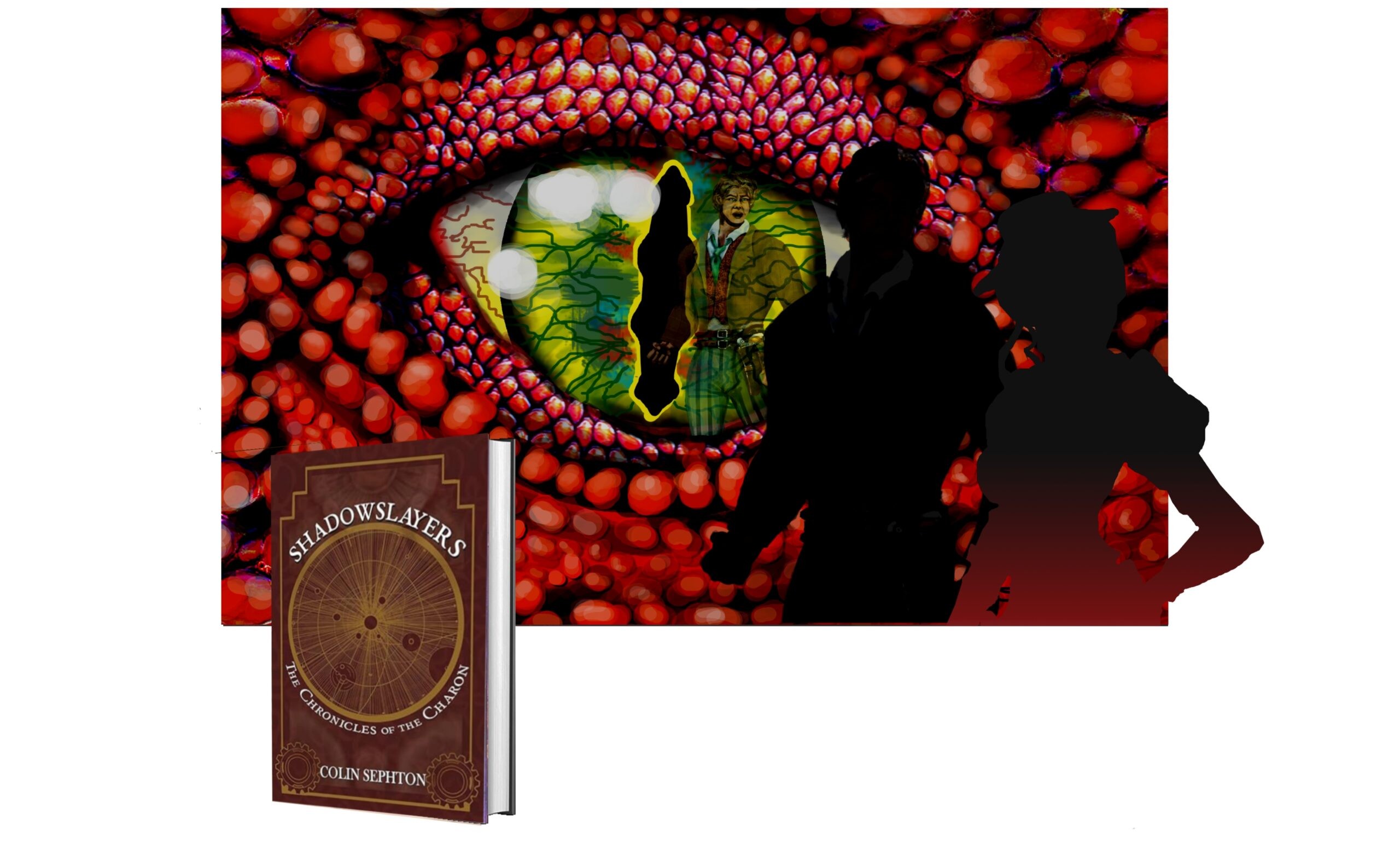
Image from the front cover of the shadowslayers book by Colin Sephton. Used for the shadowslayers review 1 and shadowslayers review 2

Shadowslayers Review 3: The Book of Echoes, Secrets, and a Fractured Fate

Sephton, October 5, 2025October 18, 2025

Shadowslayers review 3

We’re excited to welcome Colin Sephton back to the blog to discuss his latest novel, Shadowslayers From the Chronicles of the Charon. Following the award-winning Timeslayers, this second volume dives deeper into a fractured cosmos where myths and machines collide. At its centre lies a mysterious and terrifying relic, the Book of Shadows, a tome that tempts, corrupts, and threatens to reshape existence itself. In this guest post, Colin explores how this forbidden book drives the story and what it reveals about the dangers of knowledge pursued without balance.

Fantasy often turns on artefacts of immense power, a sword that crowns kings, a jewel that curses empires, or a relic that decides wars. In Colin Sephton’s Shadowslayers, From the Chronicles of the Charon, the most dangerous object is not forged of steel but bound in mystery: the Book of Shadows. This enigmatic tome emerges as both promise and threat, carrying within it the weight of gods, the burden of knowledge, and the fate of worlds already cracked apart.

More than parchment or spell craft, the Book of Shadows is alive with menace. To touch it is to risk not only one’s life, but the balance of existence itself.

Origins Wrapped in Darkness

Where the Book of Consciousness symbolised creation and the fragile thread of cosmic order, the Book of Shadows carries the opposite energy: secrecy, vengeance, and unraveling. Whispers say it has drifted between planes for centuries, hidden by enchantments that resist discovery . Unlike any earthly manuscript, its words are not meant to be catalogued or studied. They are traps for the unprepared, riddles meant to consume the one who dares read them.

Its presence in Shadowslayers is less about enlightenment than temptation. It is not the voice of wisdom but the shadow of ruin.

Indigo’s Encounter and the Threat of Skoto

The first mention of the Book comes not from scholars but from assassins. Indigo Gemstone’s kidnapping by the sinister twins Skoto reveals the tome’s central role in the fractured cosmos . To them, Indigo is not merely a Union Jack agent, she is a key. They claim she holds the path to Rahu, the name they give the Book of Shadows. Their obsession is not knowledge for growth, but knowledge as a weapon.

Through Indigo’s ordeal, Sephton makes the danger clear: this is not a book of enlightenment but of manipulation. Those who seek it serve masters that hunger for destruction.

Shadows of Obsession and Desperation

The Book of Shadows tempts in different ways than its predecessor. For the obsessed, it promises ultimate power; for the desperate, it offers escape. In both cases, the result is ruin. Skoto’s violent devotion to its recovery mirrors humanity’s oldest pattern: the pursuit of forbidden secrets even when warnings abound. If Timeslayers showed us how Skye’s desperation unleashed the Charon, Shadowslayers warns us that new players, driven by ambition or survival, are always ready to repeat the same mistakes.

Knowledge as Weapon, Not Wisdom

Unlike a cannon or sonic blaster, the Book of Shadows does not destroy directly. Instead, it corrupts. It multiplies fear, fractures truth, and binds its reader to the will of darker forces. In a city where steam machines already stretch the limits of human control, the Book of Shadows is a reminder that the greatest danger is not always mechanical. It is ideological. It reshapes the mind before it reshapes the world.

This makes it more powerful than any invention Ignatius could engineer, for its reach lies not in gears or sound, but in human belief itself.

What the Book of Shadows Means for Readers

Sephton does not present the Book of Shadows as mere decoration, it is a mirror. Humanity’s history is filled with quests for knowledge that brought both brilliance and devastation: fire, steam, electricity, nuclear power. Every breakthrough asks the same question: What will you do with me? The Book of Shadows becomes the latest embodiment of that question. Will it be used to heal the fractured cosmos, or to plunge it into eternal ruin?

For readers, the lesson is timeless: knowledge cannot be separated from responsibility. The shadows we summon through reckless pursuit may multiply until they consume us.

Conclusion: A Tome of Temptation, A Tale of Warning

At the heart of Shadowslayers lies a paradox: knowledge promises power, but in the wrong hands it becomes poison. The Book of Shadows embodies this tension. For Skoto, it is destiny. For Indigo, it is a threat she must resist. For the cosmos, it may be the final fracture that decides whether light survives at all.

Through this enigmatic tome, Colin Sephton gives us more than an artefact of fantasy. He offers a cautionary tale about the pursuit of secrets too heavy to bear. Books can illuminate, but they can also devour. And in a fractured world where shadows multiply, even a single page may change everything.

Amazon Link


Discover more from Colin Sephton Author

Subscribe to get the latest posts sent to your email.

Book Blogs

Post navigation

Previous post
Next post

Related Posts

Book Blogs Image from the front cover of the shadowslayers book by Colin Sephton. Used for the shadowslayers review 1 and shadowslayers review 2

Shadowslayers Review 2: Unlock An Intriguing Journey Through Darkness, What holds the Power

September 20, 2025October 5, 2025

Colin Sephton’s Shadowslayers, from the Chronicles of the Charon, continues the saga that began with…

Read More
Book Blogs

Soulslayers Review 2: When the Soul Becomes a Weapon

December 8, 2025December 8, 2025

In the 3rd book of the trilogy, Soulslayers From the Chronicles of the Charon, Colin…

Read More
Book Blogs Poster showing the cover of the latest book by Colin Sephton. Promotion for his latest virtual book tour

Soulslayers: Book Tour 2025 – The Fascinating Final to the Trilogy

November 16, 2025November 16, 2025

Soulslayers – Book bloggers and interviewers have been engaging with the author to gain deeper…

Read More

Fresh Off the Press: My Latest Blogs

Head and shoulders picture of Author Colin Sephton smiling to encourage you to subscribe
  • Why Fantasy Needs Philosophy AgainSeptember 20, 2026
  • George Lucas, Narrative Art and the Mysteries of LifeSeptember 12, 2026
  • Star Wars is Mythology for the Modern Technological Age.September 5, 2026
  • How Ancient Myth Became Science FictionAugust 30, 2026
  • Have The Mythological Gods Changed?August 23, 2026
  • Are We Living Inside a Universal Mind?August 19, 2026

Don’t Miss Out — Join Now!


Revealing Moments: My Author Interview with the Publishers


Connect With Me Across the Web

  • Amazon
  • Goodreads
  • Instagram
  • TikTok
  • Facebook
  • Etsy
  • DeviantArt

Discover My World on IG @timeslayers

Would you want to know your future if you had the chance? It sounds tempting. But imagine knowing exactly what was going to happen—and knowing that you couldn’t change it. Would your choices still have meaning? The tension between fate and free will appears again and again in mythology. From the Greek Fates to the Norse Norns, human beings have imagined forces that weave the pattern of our lives. It’s also a recurring question in philosophy: are we genuinely free, or are our choices determined by everything that came before? These questions have a particular significance in my own fiction, where characters are repeatedly confronted with visions of possible futures and have to decide whether destiny is something to accept, or something to challenge. This is one of the reasons I see fantasy as more than escapism. Fantasy gives us a safe place to explore questions about reality, choice and what it means to be human. I’m exploring these ideas further through the philosophy, mythology and stories behind my novels on my website, sephtonart.com. If you could see your future, would you want to know? #timeslayers #destiny #determinism #freewill #philosophy No words. Just find it hilarious! #timeslayers Over the years I have been inspired by lots of books, artwork and music. From a really young age I was buying Spider-Man and Hulk comics and as I got older I became fascinated with all things cosmic and mythological. So I started to read the Eternals, Thor, Doctor Strange, the Inhumans, Galactus & the Silver Surfer, and Captain Marvel-Vell (when Captain Marvel was a male alien!) Then came Star Wars! I discovered Conan and Elric and the artwork of Boris Vallejo and Frank Frazetta, with the Elric saga becoming my all-time favourite. This and my studies of mysticism, metaphysics and the esoteric, and the world building in my head was such I could use all this to create my own world! #timeslayers #conan #elric #shelfie #inspiration Almost every culture has created heroes. From Achilles and Hercules to King Arthur, from Luke Skywalker to Superman, the characters change, but the questions remain remarkably similar. What do we do when confronted by forces greater than ourselves? What are we willing to sacrifice? Can we overcome our fears? And what might we become through the experience? The interesting thing about mythological heroes is that they aren’t necessarily perfect. Their weaknesses are often as important as their strengths. Perhaps that’s why we continue to reinvent the hero. The ancient hero became the knight. The knight became the pulp adventurer. The adventurer became the superhero. And now the hero can even travel across galaxies. The stories evolve because we evolve. This is part of what interests me about modern mythology and why I believe fantasy and science fiction continue to perform a role that mythology has always performed: giving us stories through which we can explore what it means to be human. It’s also one of the ideas at the heart of The Chronicles of the Charon. Who is your favourite modern mythic hero, and what do they represent to you? Let me know in the comments. And follow for more next week, and checkout my website, sephtonart.com. #timeslayers #mythology #modernmyth #mythmaking #fantasy Who are you? We normally think of identity as something obvious. We have a name, a face, a history and a personality. But look a little closer and things become much more complicated. Your body changes. Your memories change. Your opinions change. Even your personality can change dramatically throughout your life. Yet somehow, you still experience yourself as the same person. So what is this “self” that seems to remain? This is one of the questions that lies beneath much of my writing. My novels explore identity, consciousness, the soul and the possibility that there is more to human existence than the physical world we experience. I’m interested in the space where philosophy, mythology and fantasy meet, and that exploration continues on my website. If you removed your memories, your body and your personality, what would be left? If you enjoyed this, like and subscribe (for free) on my website. #timeslayers #philosophicalfriday #consciousness #soul #existentialism A quick shelfie today. I’m often asked where I get my ideas from for my world building and novels. The simple answer is EVERYWHERE! I have a large collection of books, I can’t pass a bookstore without buying one! Much to my wife’s annoyance! 😁🥰 But the spark of an idea for the Book of Consciousness came from Helena P Blavatsky’s spSecret Doctrine about the Book of Dzyan, a mystical Tibetan text made from palm leaves impervious to the elements. My trilogy, The Chronicles of the Charon incorporates some mythology, philosophy and metaphysics. All the things that keep me up at night! If you like my what you see, give me a follow and there’ll be more world building next week. Or checkout my website, sephtonart.com. #timeslayers #shelfie #worldbuilding #bookstagram #fantasynovel Meet the author… The gods of ancient mythology were powerful beings who embodied the things humans feared, admired and struggled to understand. Thor had his hammer, Hercules had his strength, Athena had her wisdom. Today, our mythology looks different. Superheroes fly. Jedi manipulate the Force. Science-fiction characters travel between worlds and confront powers beyond ordinary human experience. But underneath the technology, costumes and special effects, many of these stories are performing an ancient function. They give us larger-than-life figures through whom we can explore power, morality, sacrifice, identity and the nature of humanity. Perhaps the gods haven’t disappeared. Perhaps we’ve simply reinvented them. This is one of the ideas behind my interest in modern mythology and why I believe fantasy and science fiction can do more than entertain us. They can help us explore the deepest questions about ourselves and our universe. It’s also something I explore through the mythology and world building of my own trilogy, The Chronicles of the Charon. Who do you think is a modern god? Let me know in the comments, and follow me so you can join me next week for another Myth Making Monday OR checkout my website for lots more information, sephtonart.com. #timeslayers #mythmaking #modernmyth #mythology #superheroes

©2026 Colin Sephton Author | WordPress Theme by SuperbThemes