Skip to content
Colin Sephton Author

Writing and Art by Colin Sephton

  • Home
  • Amazon Author Page
  • Colin’s Blog
  • Free Resource Vault
  • Fine Art
  • Fantasy Art
  • Etsy Shop
  • About Colin Sephton
Colin Sephton Author

Writing and Art by Colin Sephton

Soulslayers Review 1: “This novel is one of the genre’s boldest voices”

Sephton, November 8, 2025November 9, 2025
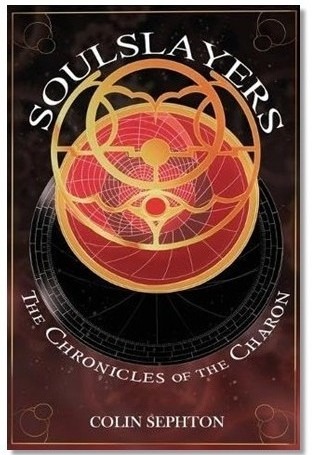
Book cover for Soulslayers: The Chronicles of the Charon by Colin Sephton, a fantasy novel featuring abstract golden and red geometric designs on a dark background. The title curves across the top, with the author’s name at the bottom.

In this Soulslayers review we can conclude that for readers drawn to the crosscurrents of philosophy, myth, and science fiction, Soulslayers confirms Colin Sephton’s place as one of the genre’s boldest voices. The saga continues to ask timeless questions in an age of machines and dares to wonder whether, somewhere in the cosmos, our souls are still listening.

When Gods Bleed and Empires Dream

Soulslayers, from the Chronicles of the Charon continues Colin Sephton’s monumental Timeslayers Saga, blending cosmic philosophy with steampunk intrigue and deeply human emotion. If Timeslayers questioned the nature of time and consciousness, Soulslayers turns inward, asking what happens when the soul itself fractures. Beneath its airships and brass machines, Sephton hides a spiritual anatomy lesson, a story about pain, redemption, and the cost of immortality.

This Soulslayers Review looks at how Sephton evolves his mythos, expanding on the Charon’s legacy while exploring the brittle machinery of both body and empire.

The Return of Indigo Gemstone: Rebirth and Ruin

At the heart of Soulslayers stands Indigo Gemstone, reborn after her cosmic ordeal. Her
resurrection scene in the prologue is one of Sephton’s most visceral passages her atoms
scattered through the cosmos, her consciousness trapped between death and divinity. She
awakens hollow, questioning whether her soul ever returned. In this, Sephton merges science
and mysticism, showing that the boundaries between body, mind, and spirit are as unstable as
time itself.

Through Indigo, Soulslayers confronts the loneliness of transcendence. She is more powerful
than before, but also more detached, unable to tell if she is still human. Her lover and partner,
Ignatius, becomes both her anchor and her mirror a man whose faith in the Union Jacks and
their imperial duty begins to crumble. Their intimacy feels fragile against the scale of cosmic
horror; their love, like the Empire they serve, is haunted by ghosts of its own making.

The Union Jacks and the Machinery of Power

Much of Soulslayers unfolds in the subterranean chambers of the Union Jacks, a secret order
masquerading as the protectors of the British Empire. Sephton paints these scenes with clockwork precision the brass doors, the riveted emblems, and the scent of oil and tea. Beneath this steampunk aesthetic lies an allegory of control: an empire obsessed with mastery not only of land, but of the very forces that bind the universe.

Through the cold bureaucrat Edward Lawrence, Sephton shows the paradox of imperial science rational minds dabbling in divine mysteries. His decision to weaponize Ignatius’s “sonic blaster” and his fascination with Indigo’s powers expose the novel’s moral tension: humanity’s endless attempt to cage the infinite. The Union Jacks’ technology is exquisite, but its soul is rotten.

In this Soulslayers Review, we see that Sephton’s brass and steam world is not nostalgia it is warning. The empire’s gears grind not only coal but conscience.

The Spirit of the Empire: Steam, Silk, and the Sky

The airship HM Spirit of the Empire serves as both setting and symbol. Its gleaming brass and mahogany decks carry Ignatius and Indigo toward Tibet a journey that mirrors the expansionist dream of the British Empire itself. The vessel is majestic yet precarious, suspended between heaven and hell. Among its glittering salons and chandeliers, intrigue festers, spies, assassins, and supernatural watchers stalk the corridors.

Sephton uses the airship as a microcosm of civilization beautiful, advanced, and doomed by its arrogance. The eagle that shadows their voyage becomes an omen, linking the mechanical and the mythic, as if the cosmos itself watches humanity’s hubris. When the compass spins wildly and engines falter, it is not just technology failing; it is the universe reminding them that progress without purpose leads only to collapse.

Souls and Science: Sephton’s Cosmic Philosophy

While Timeslayers dealt with time as a living force, Soulslayers examines the soul as vibration. Ignatius’s revelation that “all matter is a vibration” blurs the line between physics and metaphysics. Healing, resurrection, and destruction all depend on finding the right frequency. Indigo’s deadly aura and Ignatius’s healing touch are two sides of the same cosmic equation.

This idea of resonance as both weapon and salvation echoes through the story’s spiritual fabric. It transforms magic into science and faith into energy, suggesting that divinity may be nothing more (or less) than harmony with the universe. Yet the more they master this vibration, the further they drift from what makes them human. Sephton’s message is subtle but profound: enlightenment without empathy is annihilation.

The Hidden Enemy: When the Empire Turns Inward

The novel’s intrigue deepens when the airship is sabotaged and Ignatius’s quarters are ransacked. The attack exposes not just espionage but the psychological rot of empire loyalty twisted into paranoia, and service transformed into sacrifice. Lambeth, the loyal servant, becomes the novel’s quiet tragedy: a man wounded in the shadows of greater powers, representing the human cost of divine ambition.

The spies, shapeshifters, and cosmic predators that pursue the heroes are terrifying, but the real threat lies within the human soul the greed for knowledge, the lust for control, and the fear of death. Through these layers, Soulslayers earns its title, the true slayers of souls are not gods, but people who forget what the soul is for.

From the Charon to the Cosmos: The Saga Expands

In expanding the mythology of the Charon, Sephton elevates the saga from dark fantasy to cosmic epic. The Charon, once ethereal overseers of death and time, now loom as silent witnesses to humanity’s self-destruction. The novel hints that their imprisonment and the rise of the Union Jacks are connected that history itself is repeating a divine cycle of hubris and fall.

Where Timeslayers ended in revelation, Soulslayers begins in consequence. The cosmic order trembles, and Indigo’s altered nature may be the key, or the curse, that determines whether the next age belongs to gods or mortals.

What Soulslayers Teaches Us

Sephton’s prose remains richly cinematic ornate yet precise, filled with the sounds of steam valves, clockwork hearts, and the silence of deep space. But beneath the spectacle lies the same moral gravity that made Timeslayers a modern classic. The book asks: What does it mean to survive without a soul? Can love endure when memory and matter are mutable? And when empires dream of heaven, who pays the price?

Soulslayers is not just the continuation of a saga; it is the introspection of it. If Timeslayers was about mastering time, Soulslayers is about mastering the self—and realizing that the two may be the same thing.

Conclusion: The Empire Within

In the end, Soulslayers, From the Chronicles of the Charon proves that fantasy can be both mythic and intimate. Sephton’s world of steam and spirit is not escapism it is a mirror, polished in brass and blood. The novel’s haunting beauty lies in its refusal to offer easy answers. It suggests that progress and salvation, empire and enlightenment, all demand the same sacrifice: the soul itself.

Link to Amazon
Next Post …


Discover more from Colin Sephton Author

Subscribe to get the latest posts sent to your email.

Book Blogs

Post navigation

Previous post
Next post

Related Posts

Book Blogs Details of the Timeslayers, Shadowslayers and Soulslayers Spotify playlists by Colin Sephton

Three Playlists Now Available on Spotify

July 15, 2026July 18, 2026

Available now as a playlist on Spotify, why not enjoy listening to a playlist of…

Read More
Book Blogs

Soulslayers Review 3: When the Soul Becomes the Final Frontier

February 14, 2026February 14, 2026

Soulslayers Review 3 Colin Sephton’s Soulslayers from the Chronicles of the Charon asks a question…

Read More
Book Blogs Poster showing the cover of the latest book by Colin Sephton. Promotion for his latest virtual book tour

Soulslayers: Book Tour 2025 – The Fascinating Final to the Trilogy

November 16, 2025November 16, 2025

Soulslayers – Book bloggers and interviewers have been engaging with the author to gain deeper…

Read More

Fresh Off the Press: My Latest Blogs

Head and shoulders picture of Author Colin Sephton smiling to encourage you to subscribe
  • Why Fantasy Needs Philosophy AgainSeptember 20, 2026
  • George Lucas, Narrative Art and the Mysteries of LifeSeptember 12, 2026
  • Star Wars is Mythology for the Modern Technological Age.September 5, 2026
  • How Ancient Myth Became Science FictionAugust 30, 2026
  • Have The Mythological Gods Changed?August 23, 2026
  • Are We Living Inside a Universal Mind?August 19, 2026

Don’t Miss Out — Join Now!


Revealing Moments: My Author Interview with the Publishers


Connect With Me Across the Web

  • Amazon
  • Goodreads
  • Instagram
  • TikTok
  • Facebook
  • Etsy
  • DeviantArt

Discover My World on IG @timeslayers

Would you want to know your future if you had the chance? It sounds tempting. But imagine knowing exactly what was going to happen—and knowing that you couldn’t change it. Would your choices still have meaning? The tension between fate and free will appears again and again in mythology. From the Greek Fates to the Norse Norns, human beings have imagined forces that weave the pattern of our lives. It’s also a recurring question in philosophy: are we genuinely free, or are our choices determined by everything that came before? These questions have a particular significance in my own fiction, where characters are repeatedly confronted with visions of possible futures and have to decide whether destiny is something to accept, or something to challenge. This is one of the reasons I see fantasy as more than escapism. Fantasy gives us a safe place to explore questions about reality, choice and what it means to be human. I’m exploring these ideas further through the philosophy, mythology and stories behind my novels on my website, sephtonart.com. If you could see your future, would you want to know? #timeslayers #destiny #determinism #freewill #philosophy No words. Just find it hilarious! #timeslayers Over the years I have been inspired by lots of books, artwork and music. From a really young age I was buying Spider-Man and Hulk comics and as I got older I became fascinated with all things cosmic and mythological. So I started to read the Eternals, Thor, Doctor Strange, the Inhumans, Galactus & the Silver Surfer, and Captain Marvel-Vell (when Captain Marvel was a male alien!) Then came Star Wars! I discovered Conan and Elric and the artwork of Boris Vallejo and Frank Frazetta, with the Elric saga becoming my all-time favourite. This and my studies of mysticism, metaphysics and the esoteric, and the world building in my head was such I could use all this to create my own world! #timeslayers #conan #elric #shelfie #inspiration Almost every culture has created heroes. From Achilles and Hercules to King Arthur, from Luke Skywalker to Superman, the characters change, but the questions remain remarkably similar. What do we do when confronted by forces greater than ourselves? What are we willing to sacrifice? Can we overcome our fears? And what might we become through the experience? The interesting thing about mythological heroes is that they aren’t necessarily perfect. Their weaknesses are often as important as their strengths. Perhaps that’s why we continue to reinvent the hero. The ancient hero became the knight. The knight became the pulp adventurer. The adventurer became the superhero. And now the hero can even travel across galaxies. The stories evolve because we evolve. This is part of what interests me about modern mythology and why I believe fantasy and science fiction continue to perform a role that mythology has always performed: giving us stories through which we can explore what it means to be human. It’s also one of the ideas at the heart of The Chronicles of the Charon. Who is your favourite modern mythic hero, and what do they represent to you? Let me know in the comments. And follow for more next week, and checkout my website, sephtonart.com. #timeslayers #mythology #modernmyth #mythmaking #fantasy Who are you? We normally think of identity as something obvious. We have a name, a face, a history and a personality. But look a little closer and things become much more complicated. Your body changes. Your memories change. Your opinions change. Even your personality can change dramatically throughout your life. Yet somehow, you still experience yourself as the same person. So what is this “self” that seems to remain? This is one of the questions that lies beneath much of my writing. My novels explore identity, consciousness, the soul and the possibility that there is more to human existence than the physical world we experience. I’m interested in the space where philosophy, mythology and fantasy meet, and that exploration continues on my website. If you removed your memories, your body and your personality, what would be left? If you enjoyed this, like and subscribe (for free) on my website. #timeslayers #philosophicalfriday #consciousness #soul #existentialism A quick shelfie today. I’m often asked where I get my ideas from for my world building and novels. The simple answer is EVERYWHERE! I have a large collection of books, I can’t pass a bookstore without buying one! Much to my wife’s annoyance! 😁🥰 But the spark of an idea for the Book of Consciousness came from Helena P Blavatsky’s spSecret Doctrine about the Book of Dzyan, a mystical Tibetan text made from palm leaves impervious to the elements. My trilogy, The Chronicles of the Charon incorporates some mythology, philosophy and metaphysics. All the things that keep me up at night! If you like my what you see, give me a follow and there’ll be more world building next week. Or checkout my website, sephtonart.com. #timeslayers #shelfie #worldbuilding #bookstagram #fantasynovel Meet the author… The gods of ancient mythology were powerful beings who embodied the things humans feared, admired and struggled to understand. Thor had his hammer, Hercules had his strength, Athena had her wisdom. Today, our mythology looks different. Superheroes fly. Jedi manipulate the Force. Science-fiction characters travel between worlds and confront powers beyond ordinary human experience. But underneath the technology, costumes and special effects, many of these stories are performing an ancient function. They give us larger-than-life figures through whom we can explore power, morality, sacrifice, identity and the nature of humanity. Perhaps the gods haven’t disappeared. Perhaps we’ve simply reinvented them. This is one of the ideas behind my interest in modern mythology and why I believe fantasy and science fiction can do more than entertain us. They can help us explore the deepest questions about ourselves and our universe. It’s also something I explore through the mythology and world building of my own trilogy, The Chronicles of the Charon. Who do you think is a modern god? Let me know in the comments, and follow me so you can join me next week for another Myth Making Monday OR checkout my website for lots more information, sephtonart.com. #timeslayers #mythmaking #modernmyth #mythology #superheroes

©2026 Colin Sephton Author | WordPress Theme by SuperbThemes