Skip to content
Colin Sephton Author

Writing and Art by Colin Sephton

  • Home
  • Amazon Author Page
  • Colin’s Blog
  • Free Resource Vault
  • Fine Art
  • Fantasy Art
  • Etsy Shop
  • About Colin Sephton
Colin Sephton Author

Writing and Art by Colin Sephton

Soulslayers Review 3: When the Soul Becomes the Final Frontier

Sephton, February 14, 2026February 14, 2026
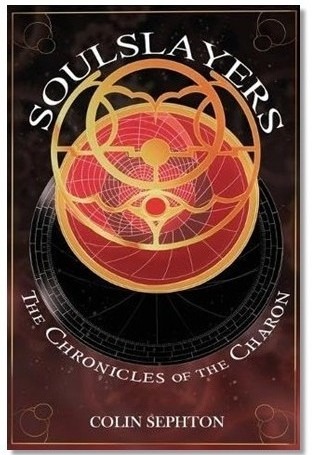
Book cover for Soulslayers and also for Soulslayers review 1 and Soulslayers review 2 and Review 3. The Chronicles of the Charon by Colin Sephton, a fantasy novel featuring abstract golden and red geometric designs on a dark background. The title curves across the top, with the author’s name at the bottom.

Soulslayers Review 3

Colin Sephton’s Soulslayers from the Chronicles of the Charon asks a question as old as humanity and as modern as the age of artificial intelligence: what happens when the soul itself becomes something to study, manipulate, and weaponize? In this third entry of the Timeslayers Saga, Sephton replaces time with transcendence, turning his focus from the fabric of history to the essence of existence. The result is a work that feels both spiritual and scientific, a story of love, loss, and the peril of divine ambition.

The Soul as Science: Energy, Consciousness, and Creation

In Soulslayers, knowledge takes on an even more intimate form than in Timeslayers. Ignatius, still haunted by his cosmic discoveries, finds that the human soul is not just spirit, it is vibration, a pattern of energy that links all living things to the universe itself. Sephton blends metaphysics with physics, suggesting that the laws of creation can be read like equations if one dares to look deep enough.

This transformation of the soul into something quantifiable opens both wonder and danger. The same technology that allows Ignatius to heal a dying man can also unmake existence itself. Just as the Book of Turiya once corrupted its readers with forbidden knowledge, Soulslayers shows that even enlightenment can turn lethal when stripped of empathy.

Indigo Gemstone: Between Life, Death, and Divinity

Indigo Gemstone’s ordeal forms the emotional heart of Soulslayers. Once human, now something more, and less, than human, she embodies the price of transcendence. Her trauma is not triumph but torment. She can manipulate matter, sense cosmic vibrations, and destroy with a touch, yet she feels hollow, disconnected from her own humanity.

Sephton crafts Indigo as both goddess and ghost. Her suffering becomes the novel’s meditation on identity: when every atom is remade, where does the “self” go? Through her, Soulslayers becomes a study of trauma and rebirth, the struggle to find meaning after the boundaries of life have been shattered. Indigo’s pain echoes every reader who has ever felt changed by loss, alive, but never the same.

Ignatius and the Ethics of Resurrection

If Indigo embodies the soul’s fracture, Ignatius represents its manipulation. His growing ability to harness “resonant frequencies” to heal or harm blurs the line between science and miracle. In one of the novel’s most haunting scenes, he revives his mortally wounded servant, only to realize that each act of creation exacts a spiritual toll.

Sephton uses Ignatius to explore a moral paradox: if one can conquer death, should one? Ignatius’s dilemma mirrors humanity’s own pursuit of control, over nature, over knowledge, over fate. In his hands, salvation and damnation share the same tools. Through him, Soulslayers suggests that every technological or spiritual breakthrough carries a hidden cost: the erosion of humility.

The Union Jacks and the Machinery of Empire

The Union Jacks, the secretive organization beneath the British Museum, remain Sephton’s grand metaphor for the corruption of progress. Beneath their ornate crests and brass doors lies an empire desperate to own the soul itself. They no longer fight merely for land or power, but for dominion over life and afterlife.

Under the ruthless leadership of Edward Lawrence, the Union’s laboratories evolve into sanctuaries of desecration. Indigo’s abilities are catalogued, tested, and exploited. Ignatius’s inventions are stripped of meaning and remade as weapons. In this way, Soulslayers transforms steampunk spectacle into moral allegory: the Empire’s machines are magnificent, but its soul has gone cold.

The Airship as a Symbol of Fragile Grandeur

The HM Spirit of the Empire stands as one of Sephton’s finest metaphors. Glittering and grand, the airship carries its passengers, scientists, aristocrats, spies, above the clouds, yet it is weighed down by invisible guilt. When its compasses spin wildly and mechanical failures strike, Sephton turns technological malfunction into spiritual metaphor: humanity has lost its true direction.

As Indigo and Ignatius journey toward Tibet in search of the Celestial Pearl, the ship becomes a vessel of destiny, a microcosm of the Empire itself, beautiful but doomed. The scenes aboard it capture Sephton’s gift for blending spectacle with symbolism, showing how every triumph of invention conceals the seeds of collapse.

The Celestial Pearl and the Promise of Eternity

If Timeslayers revolved around the Book of Consciousness, Soulslayers introduces a new relic, the Flaming Celestial Pearl. Said to contain remnants of the universe’s first light, it represents the purest form of energy: creation itself. Lawrence and the Union see it as the next step toward a “Celestial Empire,” one that would rule not only the Earth but the heavens.

Yet Sephton treats the Pearl not as treasure but as temptation. Like the Book before it, it reveals how the hunger for power always disguises itself as curiosity. The Pearl becomes the story’s moral compass: a reminder that the brightest light casts the darkest shadow.

The Philosophical Core: When the Soul Replaces the Machine

At its deepest level, Soulslayers transforms the classic steampunk genre into metaphysical reflection. The machines, gears, and engines that defined Timeslayers are still here, but now they hum with spiritual consequence. The narrative suggests that humanity’s true invention is not mechanical, it is metaphysical. We build empires not from brass, but from belief.

Sephton pushes this idea to its limit: when the soul becomes data, when emotion becomes energy, the human being risks becoming machine. The result is a chilling yet beautiful vision of a future where enlightenment and extinction share the same frequency.

Lessons from the Fractured Soul

In Soulslayers, the pursuit of ultimate truth shifts inward. The war is no longer fought between nations or gods, it is fought within. Through Indigo’s grief, Ignatius’s guilt, and the Union’s hubris, Sephton shows that every civilization’s downfall begins with its misunderstanding of the soul.

The novel warns that knowledge without compassion becomes tyranny, and progress without humility becomes apocalypse. Its message resonates far beyond fantasy: in an age of artificial intelligence, cloning, and quantum exploration, Soulslayers speaks directly to our modern anxieties. The soul, it reminds us, is not a resource to be mined. It is the only mystery worth preserving.

Conclusion: The Empire Beyond Flesh

Soulslayers from the Chronicles of the Charon is both continuation and culmination, a story that expands the myths of the Charon while narrowing its focus to the human heart. Colin Sephton delivers a meditation on mortality disguised as an adventure novel, a steampunk epic that doubles as a sermon on the ethics of power.

In the end, the book’s greatest revelation is not that humans can touch the divine, it’s that they never should. Soulslayers asks not how we conquer the cosmos, but how we protect the small, flickering light within ourselves. In a world obsessed with immortality, Sephton dares to ask the harder question:
Is a soul still a soul if it no longer remembers pain?

Link to Amazon
Next Post …


Discover more from Colin Sephton Author

Subscribe to get the latest posts sent to your email.
Book Blogs

Post navigation

Previous post
Next post

Related Posts

Shadowslayers: A Multiverse Thriller Unveiled – Review April 2026

April 15, 2026July 15, 2026

Shadowslayers is exactly the kind of genre bending cosmic adventure that fans of British sci…

Read More
Book Blogs Timeslayers award-winning fantasy novel by Colin Sephton

Timeslayers Review: Do the readers think it has hidden depth?

September 3, 2024September 21, 2025

Unveiling the Charon: Light, Darkness, and the Fate of Time in Timeslayers Timeslayers Review –…

Read More
Book Blogs Timeslayers award-winning fantasy novel by Colin Sephton

Timeslayers Review 3: What Happens When Proven Knowledge becomes Transformative?

November 5, 2024October 20, 2025

Sephton’s novel shows that ultimate knowledge carries ultimate risk. The Book of Consciousness tempts scholars,…

Read More

Fresh Off the Press: My Latest Blogs

Head and shoulders picture of Author Colin Sephton smiling to encourage you to subscribe
  • What Is Modern Mythology? Can We Create Myths Today?September 27, 2026
  • Why Fantasy Needs Philosophy AgainSeptember 20, 2026
  • George Lucas, Narrative Art and the Mysteries of LifeSeptember 12, 2026
  • Star Wars is Mythology for the Modern Technological Age.September 5, 2026
  • How Ancient Myth Became Science FictionAugust 30, 2026
  • Have The Mythological Gods Changed?August 23, 2026

Don’t Miss Out — Join Now!


Revealing Moments: My Author Interview with the Publishers


Connect With Me Across the Web

  • Amazon
  • Goodreads
  • Instagram
  • TikTok
  • Facebook
  • Etsy
  • DeviantArt

Discover My World on IG @timeslayers

If you are interested in fantasy, modern mythology, philosophy, fantasy art check out my website sephtonart.com and get my blog every Sunday. #timeslayers #mythology #modernmyth #philosophy #fantasyart Would you want to know your future if you had the chance? It sounds tempting. But imagine knowing exactly what was going to happen—and knowing that you couldn’t change it. Would your choices still have meaning? The tension between fate and free will appears again and again in mythology. From the Greek Fates to the Norse Norns, human beings have imagined forces that weave the pattern of our lives. It’s also a recurring question in philosophy: are we genuinely free, or are our choices determined by everything that came before? These questions have a particular significance in my own fiction, where characters are repeatedly confronted with visions of possible futures and have to decide whether destiny is something to accept, or something to challenge. This is one of the reasons I see fantasy as more than escapism. Fantasy gives us a safe place to explore questions about reality, choice and what it means to be human. I’m exploring these ideas further through the philosophy, mythology and stories behind my novels on my website, sephtonart.com. If you could see your future, would you want to know? #timeslayers #destiny #determinism #freewill #philosophy No words. Just find it hilarious! #timeslayers Over the years I have been inspired by lots of books, artwork and music. From a really young age I was buying Spider-Man and Hulk comics and as I got older I became fascinated with all things cosmic and mythological. So I started to read the Eternals, Thor, Doctor Strange, the Inhumans, Galactus & the Silver Surfer, and Captain Marvel-Vell (when Captain Marvel was a male alien!) Then came Star Wars! I discovered Conan and Elric and the artwork of Boris Vallejo and Frank Frazetta, with the Elric saga becoming my all-time favourite. This and my studies of mysticism, metaphysics and the esoteric, and the world building in my head was such I could use all this to create my own world! #timeslayers #conan #elric #shelfie #inspiration Almost every culture has created heroes. From Achilles and Hercules to King Arthur, from Luke Skywalker to Superman, the characters change, but the questions remain remarkably similar. What do we do when confronted by forces greater than ourselves? What are we willing to sacrifice? Can we overcome our fears? And what might we become through the experience? The interesting thing about mythological heroes is that they aren’t necessarily perfect. Their weaknesses are often as important as their strengths. Perhaps that’s why we continue to reinvent the hero. The ancient hero became the knight. The knight became the pulp adventurer. The adventurer became the superhero. And now the hero can even travel across galaxies. The stories evolve because we evolve. This is part of what interests me about modern mythology and why I believe fantasy and science fiction continue to perform a role that mythology has always performed: giving us stories through which we can explore what it means to be human. It’s also one of the ideas at the heart of The Chronicles of the Charon. Who is your favourite modern mythic hero, and what do they represent to you? Let me know in the comments. And follow for more next week, and checkout my website, sephtonart.com. #timeslayers #mythology #modernmyth #mythmaking #fantasy Who are you? We normally think of identity as something obvious. We have a name, a face, a history and a personality. But look a little closer and things become much more complicated. Your body changes. Your memories change. Your opinions change. Even your personality can change dramatically throughout your life. Yet somehow, you still experience yourself as the same person. So what is this “self” that seems to remain? This is one of the questions that lies beneath much of my writing. My novels explore identity, consciousness, the soul and the possibility that there is more to human existence than the physical world we experience. I’m interested in the space where philosophy, mythology and fantasy meet, and that exploration continues on my website. If you removed your memories, your body and your personality, what would be left? If you enjoyed this, like and subscribe (for free) on my website. #timeslayers #philosophicalfriday #consciousness #soul #existentialism A quick shelfie today. I’m often asked where I get my ideas from for my world building and novels. The simple answer is EVERYWHERE! I have a large collection of books, I can’t pass a bookstore without buying one! Much to my wife’s annoyance! 😁🥰 But the spark of an idea for the Book of Consciousness came from Helena P Blavatsky’s spSecret Doctrine about the Book of Dzyan, a mystical Tibetan text made from palm leaves impervious to the elements. My trilogy, The Chronicles of the Charon incorporates some mythology, philosophy and metaphysics. All the things that keep me up at night! If you like my what you see, give me a follow and there’ll be more world building next week. Or checkout my website, sephtonart.com. #timeslayers #shelfie #worldbuilding #bookstagram #fantasynovel Meet the author…

©2026 Colin Sephton Author | WordPress Theme by SuperbThemes