“Arthur was ware of an arm clothed in white samite, that held a fair sword in the midst of the lake”
Le Morte d’Arthur by Thomas Malory
Throughout human history, we have imagined mythological weapons that are more than weapons. The hammer of Thor, Mjölnir, does not simply crush its enemies. It carries the power of thunder and lightning and represents the might of the god who wields it. Excalibur is more than a sword; it is inseparable from the legend of King Arthur and his right to rule. In modern mythology, the lightsaber has taken on a similar role. Although presented as a weapon of the future, it functions in much the same way as the enchanted weapons of ancient myth. It is an outward expression of the power, discipline and identity of the Jedi who carries it. Perhaps this is why magical weapons appear so frequently in mythology. They give physical form to something that is otherwise invisible, power. A weapon is also an unusually effective mythological symbol because it has two contradictory qualities, it gives power but demands responsibility.
Joseph Campbell, in The Hero with a Thousand Faces, explored this idea through the mythology of the hero. Discussing the Buddhist story of Prince Five-weapons, Campbell describes the ultimate weapon not as a physical object, but as the ‘Weapon of Knowledge’ within the hero. He makes the intriguing observation that: “A consummate master would require no physical weapon at all; the power of his magic word would suffice.” Campbell’s observation suggests that the magical weapon represents something deeper than its ability to destroy. As the hero becomes more spiritually or intellectually powerful, the weapon itself can become increasingly symbolic. The sword, hammer or spear is merely the visible expression of an invisible force. If this force is invisible, then it must interact somehow with objects around it. Because all matter is nothing more than vibrating energy, perhaps that force interacts with the frequency. There it raises an interesting question: What if the ultimate weapon is not something that strikes an object, but something that changes its vibration?
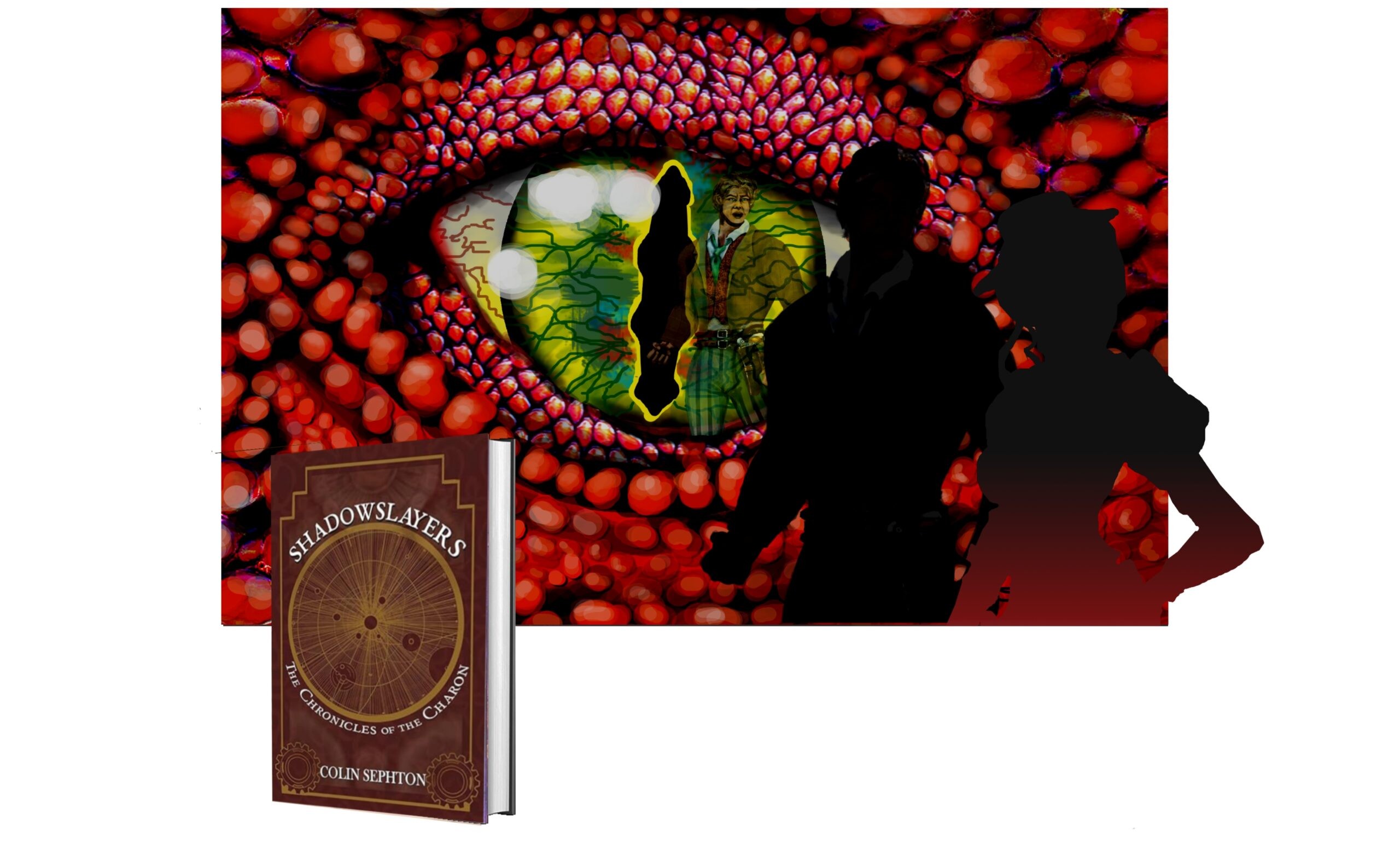
In The Chronicles of the Charon, I have explored this idea through weapons that employ sound, resonance and vibration. The concept comes from looking at the universe not simply as a collection of solid objects, but as a dynamic system of energy, movement and relationships. If matter can vibrate, and if resonance can amplify vibration, then perhaps a sufficiently powerful resonance could do more than create sound. It could disrupt the very structure of an object. Weapons, therefore, become something quite different. It does not necessarily destroy through brute force but destroys by finding the frequency at which something can no longer remain whole. In my Chronicles trilogy this led to the creation of Paladin’s halberd that was part saxophone and could be blown to create devastating music, the cosmic sitar used at the creation, the qanun, a stringed instrument, and the sonic blaster. The science behind this is based on such observations as:
“Concerning matter, we have been all wrong. What we have called matter is energy, whose vibration has been so lowered as to be perceptible to the senses. There is no matter.” Attributed to Einstein.
“If you want to find the secrets of the universe, think in terms of energy, frequency and vibration.” Nikola Tesla.
If vibration can influence physical matter, what happens when that principle is extended into the metaphysical universe? That is where weapons become interesting. Rather than relying upon conventional ammunition or physical impact, they can exploit resonance itself. The weapon doesn’t necessarily destroy something by hitting it. It makes the thing vibrate until its structure can no longer hold together. If the physical universe can be represented metaphorically as vibration, perhaps consciousness can be considered in similar terms. Scientists are exploring this idea. The ancients in the Far East have believed this for thousands of years. Nada Yoga is the ancient yogic practice and science of union through sound, vibration, and silence. The belief is the entire universe is made of vibrating energy and sound, beginning with the primal vibration Om (Aum). That sound is an attempt to make the body vibrate at the same frequency as the universe. Perhaps, ultimately, the greatest weapon in mythology has never been the sword. Perhaps it has always been knowledge of the forces that lie behind the sword. Storytellers have turned philosophical ideas into weapons. The hero acquires the weapon, but in doing so also acquires a responsibility:
- Power without consciousness becomes destruction.
- Power guided by consciousness becomes protection.
I think the ultimate example of this is the One Ring in Tolkien’s Lord of the Rings. This may be considered a weapon of sorts. Gollum’s decline is caused not just by his deep psychological addiction but his inability to understand the destructive power of the Ring. The strongest weapon isn’t necessarily the one that produces the greatest force. It is the one that understands the structure of what it is attacking. That has an obvious philosophical implication, knowledge can be more powerful than force.
In conclusion, I think throughout mythology, humanity has imagined weapons capable of doing more than ordinary weapons. They don’t simply cut, pierce or crush. They command forces that lie beyond ordinary human power. These mythological weapons are extensions of the hero who wields them. The weapon becomes a physical object through which an invisible philosophical idea is made tangible. Authors using mythological weaponry need to explore what happens when we misuse the weapon, and ultimately, does the hero control the forces of the universe, or must he/she first understand them?
Discover more from Colin Sephton Author
Subscribe to get the latest posts sent to your email.